
Blog
PSS Standardizes Investment Casting for Critical API Applications
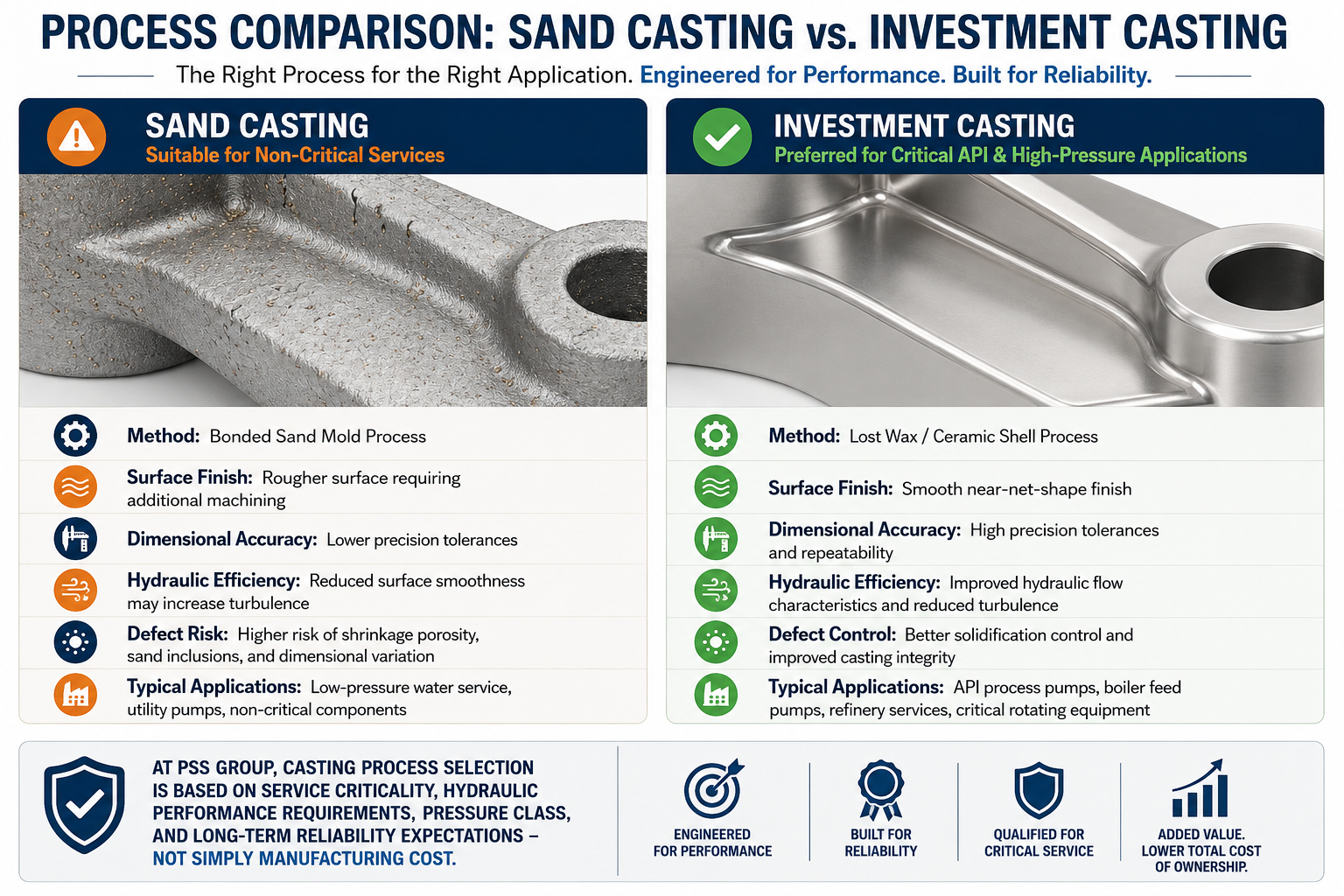
PSS Standardizes Investment Casting for Critical API Applications
The Right Casting Process for the Right Application
At PSS Group, casting process selection is not driven simply by manufacturing cost. In critical rotating equipment, the casting process directly affects hydraulic efficiency, vibration behavior, dimensional stability, and long-term equipment reliability. This is especially important in API process applications where equipment operates under high pressure, elevated temperatures, and demanding process conditions.
For this reason, PSS has standardized the use of precision investment casting (lost wax casting) for casting products used in critical API and high-pressure rotating equipment applications.
Our engineering approach considers:
- Service criticality
- Pressure class
- Hydraulic
- performance requirements
- Reliability expectations
- Long-term equipment integrity
Investment Casting vs. Sand Casting
Sand Casting
Suitable for Non-Critical Services
Sand casting remains a widely used manufacturing method throughout industry and can still be suitable for lower pressure and non-critical services such as utility water pumps, general industrial applications, and large cast components where extreme precision is not essential.
However, compared with investment casting, conventional sand casting typically produces a rougher surface finish and larger dimensional variation. This often results in additional machining requirements and a higher probability of casting defects such as shrinkage porosity or sand inclusions.
In rotating equipment, these differences can directly influence:
- Hydraulic efficiency
- Vibration behavior
- Seal reliability
- Long-term equipment performance
Investment Casting (Lost Wax Casting)
Preferred for Critical API & High-Pressure Applications
For critical API services and high-pressure applications, PSS strongly promotes precision investment casting because of the superior control it provides over geometry, dimensional accuracy, and overall casting quality.
The investment casting process uses ceramic shell molds and controlled solidification methods to produce near-net-shape components with smooth hydraulic surfaces and highly repeatable dimensions. These characteristics are particularly important in rotating equipment where even small variations in geometry can affect hydraulic performance and equipment reliability.
Key advantages of investment casting include:
- Superior dimensional accuracy
- Improved surface finish
- Better hydraulic geometry consistency
- Reduced turbulence
- Improved repeatability
- Reduced defect probability
- Better casting integrity
This process is especially valuable for hydraulic components such as:
- Pump impellers
- Diffusers
- Bowl assemblies
- Wear components
- Stainless steel flow passages
Why This Matters in Rotating Equipment
In pumps and rotating equipment, the quality of a casting has a direct influence on machine performance and reliability. Surface finish, dimensional accuracy, casting integrity, and hydraulic geometry all contribute to how efficiently a pump operates and how stable the machine behaves in service.
Poor casting quality can contribute to increased turbulence, higher vibration levels, premature seal failures, reduced bearing life, and higher overall operating costs.
By standardizing investment casting for critical applications, PSS aims to improve:
- Hydraulic efficiency
- Power consumption
- Equipment vibration
- Mechanical seal life
- Bearing reliability
- Equipment availability
- Long-term operating cost
At PSS Group, we believe critical API and high-pressure applications deserve manufacturing processes that prioritize long-term reliability and performance.
The PSS Engineering Philosophy
At PSS Group, casting process selection is based on:
- Engineering requirements
- Process criticality
- Hydraulic performance
- Reliability expectations
—not simply manufacturing cost.
This engineering-driven approach is part of our commitment to delivering superior rotating equipment solutions for critical industrial applications.
Coming Soon
In our next technical newsletter, PSS will highlight the comprehensive Inspection & Test Plan (ITP) we apply for CF3M stainless steel investment castings — including:
- Radiographic Testing (RT)
- Dye Penetrant Testing (PT)
- Heat treatment control
- Mechanical testing
- Dimensional verification
- Material traceability
- Balancing and final inspection
These inspection standards are part of the reason PSS investment castings achieve superior reliability for critical process services.
PSS Group
Engineering Solutions for Rotating Equipment
- Reverse Engineering
- Precision Investment Castings
- CFD Verification
- Pump Re-engineering
- Precision Machining
- Rotating Equipment Repair & Overhaul
- Dynamic Balancing
- Metallurgical Upgrades