
Blog
PSS Quality Control Process for Critical API Castings
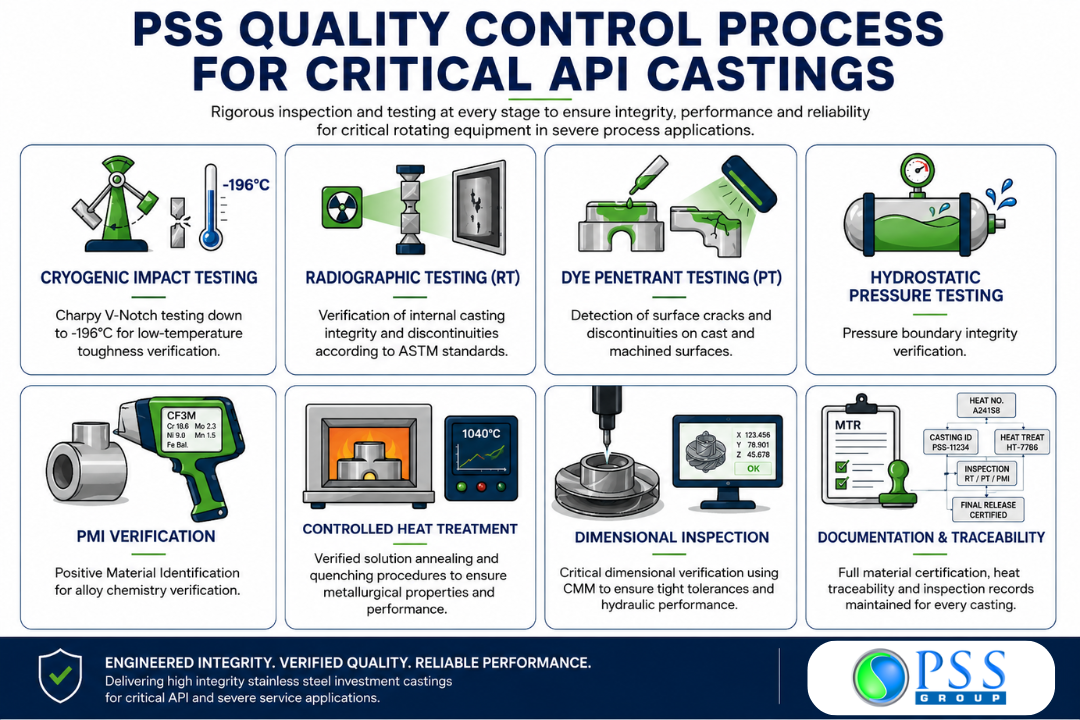
PSS Quality Control Process for Critical API Castings
Engineering Control, Inspection Discipline & Reliability Assurance for Critical Rotating Equipment
In rotating equipment, casting quality cannot be evaluated by appearance alone. Internal integrity, metallurgical consistency, dimensional accuracy, and process traceability all directly influence long-term equipment reliability.
For critical API and high-pressure applications, even small casting defects can contribute to premature failures, vibration problems, reduced hydraulic efficiency, mechanical seal issues, reduced bearing life, and long-term reliability concerns.
This is why PSS Group applies comprehensive Inspection & Test Plans (ITPs) for critical investment castings used in demanding API and high-pressure rotating equipment applications.
PSS Group itself is not a foundry. We work with approved and qualified foundry partners who are required to manufacture castings in compliance with PSS engineering requirements, inspection standards, and approved ITP procedures.
Why Critical API Castings Require Strict Inspection Control
Critical API and severe-service rotating equipment applications use a wide range of specialized casting materials depending on pressure, corrosion, temperature, erosion, and mechanical strength requirements.
Typical casting grades covered under the PSS inspection philosophy include CF3M and CF8M stainless steels, CA6NM martensitic stainless steel, duplex and super duplex stainless steels, WCB and LCB carbon steels, WC6 and WC9 chrome-moly alloy steels, as well as nickel aluminum bronze alloys.
These materials are widely used in API process pumps, boiler feed pumps, LNG and cryogenic services, offshore and seawater systems, refinery process applications, petrochemical rotating equipment, and other severe-service hydraulic applications.
Each alloy system has specific requirements for heat treatment, corrosion resistance, toughness, hardness, and inspection control. For example, CA6NM martensitic stainless steel requires careful heat treatment and toughness verification, while duplex and super duplex alloys require close control of ferrite balance and metallurgical structure.
Without proper manufacturing and inspection procedures, critical investment castings may develop shrinkage porosity, surface discontinuities, internal inclusions, hot cracking, dimensional distortion, and heat treatment inconsistencies.
The PSS Inspection Philosophy
At PSS Group, quality control begins long before the final inspection stage.
Approved foundries working with PSS are required to follow defined manufacturing, inspection, heat treatment, and traceability procedures in accordance with customer specifications and PSS quality requirements.
Our ITP approach applies inspection and verification throughout the manufacturing process — from raw material verification to final dimensional inspection and balancing — ensuring full traceability, dimensional accuracy, metallurgical consistency, and compliance with customer specifications.
Material Verification & Heat Treatment
Every casting begins with strict material verification procedures.
Chemical composition is checked according to specification requirements to ensure proper alloy content for corrosion resistance and mechanical performance. PSS also maintains full traceability throughout the manufacturing process through heat number identification, material certificates, foundry traceability records, inspection documentation, and 3.2 certification requirements where applicable.
Proper heat treatment is one of the most important stages in critical casting manufacturing. PSS ensures controlled heat treatment procedures are properly documented and monitored to achieve the required metallurgical structure, corrosion resistance, and mechanical performance.
Non-Destructive Testing (NDT)
One of the key differences in the PSS approach is the level of inspection applied to every critical casting.
Dye Penetrant Testing (PT)
PT inspection is performed on as-cast surfaces, machined surfaces, and weld repaired areas to detect surface cracks, porosity, linear indications, and other surface discontinuities.
Radiographic Testing (RT)
Radiographic testing is performed according to approved procedures and shooting plans to verify internal casting integrity. RT inspection helps identify internal porosity, shrinkage defects, inclusions, and other internal discontinuities.
Visual Inspection
Visual inspection is performed according to MSS SP-55 acceptance standards to ensure acceptable casting surface quality and workmanship.
Dimensional Inspection & Mechanical Testing
Dimensional accuracy is critical in rotating equipment because even small dimensional variations can affect hydraulic efficiency, rotor stability, mechanical seal performance, bearing reliability, and vibration behavior.
PSS performs raw casting dimensional inspection, final machining inspection, drawing verification, and critical fit and clearance verification to ensure compliance with customer drawings and engineering requirements.
Mechanical testing may include tensile testing, yield strength verification, hardness testing, elongation testing, and Charpy impact testing depending on service requirements.
Final Balancing & Reliability
For rotating equipment applications such as pump impellers, balancing quality is essential.
PSS performs final dynamic balancing according to ISO 1940 standards with full balancing documentation. Proper balancing contributes to lower vibration, improved bearing life, reduced seal failures, and improved machine reliability.
The PSS Engineering Commitment to Quality
At PSS Group, inspection and verification are not viewed simply as documentation requirements. They are part of an engineering-driven manufacturing philosophy focused on reliability, performance, and long-term equipment integrity for critical industrial applications.
Our Inspection & Test Plan philosophy is one of the reasons customers trust PSS for critical rotating equipment applications.
PSS Group
Engineering Solutions for Rotating Equipment
- Precision Investment Castings
- Reverse Engineering
- CFD Verification
- Precision Machining
- Pump Re-engineering
- Dynamic Balancing
- Metallurgical Upgrades
- Rotating Equipment Repair & Overhaul