Blog
When Overhaul Is Not Enough
How PSS Solved a Chronic Boiler Feed Pump Problem After Nine Unsuccessful OEM Reworks
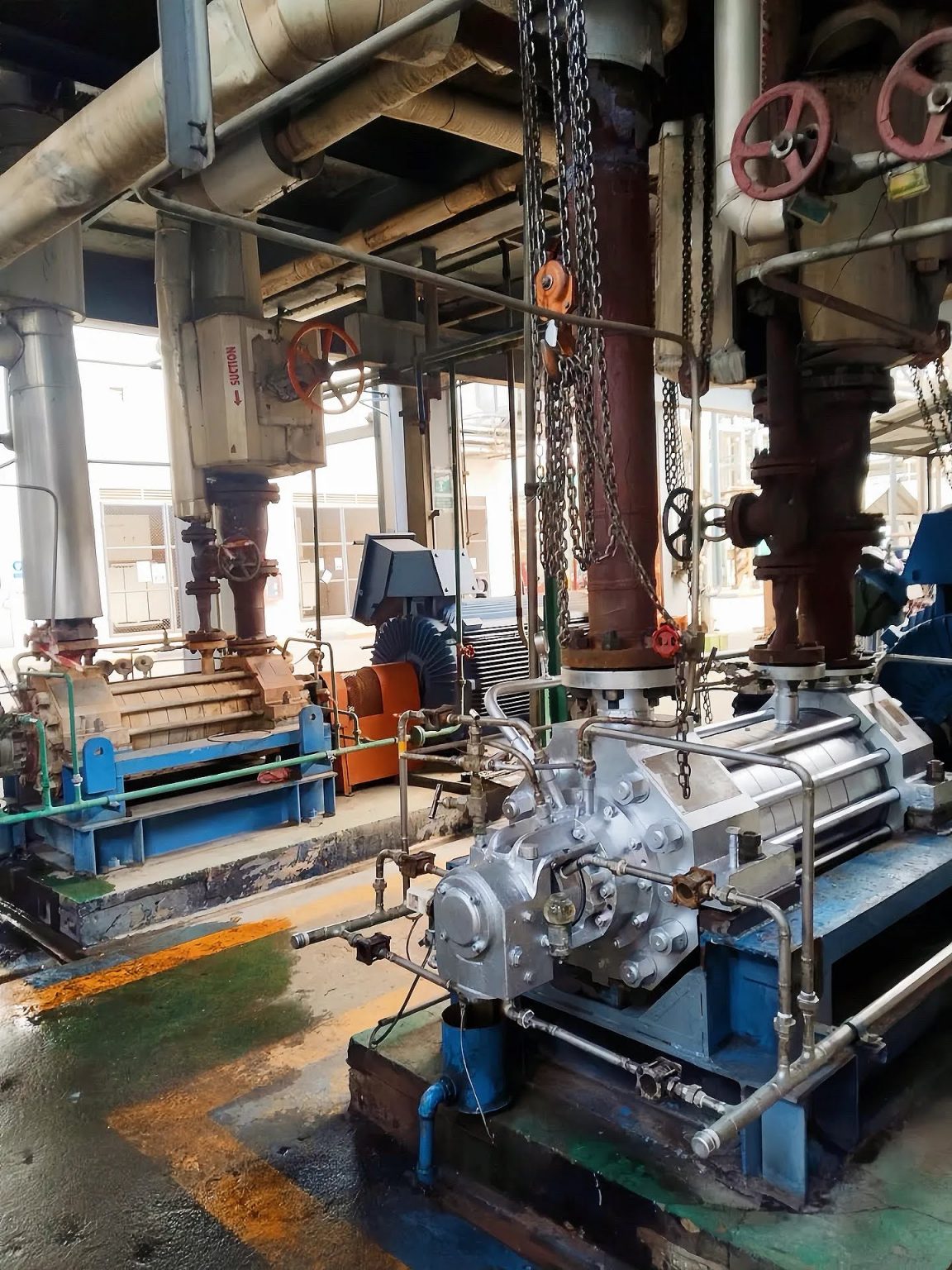
A KSB HGC 4/9 boiler feed pump at Siam Kraft had suffered repeated reliability problems for years.
Before PSS became involved, the pump had reportedly been worked and reworked nine times by an international OEM. During those interventions, modifications were made not only to the pump, but also to the baseplate and connected piping system.
Despite repeated efforts, the problem remained unresolved.
When PSS was asked to take over, the challenge was no longer simply to overhaul the pump. The machine and installation had been modified repeatedly over time, while complete engineering documentation of those changes was not available.
Rebuilding the Pump
When the pump arrived at PSS, it was locked and showed extensive internal damage, including rubbing, balance-device damage, wear-ring damage, shaft-sleeve damage and journal-bearing damage.
PSS carried out a complete mechanical restoration and manufactured:
- New shaft sleeves
- New wear rings
- New balance-device components
- New babbitted journal bearings
- The impeller stages were individually balanced and the complete rotor dynamically balanced to ISO G1.0.
PSS also discovered that the stage casings had previously been changed, while the metal-seated faces were worn. Each stage casing therefore had to be weld repaired, re-machined and re-lapped before final assembly.
Historical Modifications Added Complexity
Further investigation showed that the pump no longer fully matched its original design.
One major example was the bearing-housing locating arrangement, which had been changed from a precision register fit to a dowel-pin arrangement. The modification interfered with correct re-centering after reassembly, so PSS removed the modified dowels and restored the precision register fit.
This was one of several cases where PSS had to identify and correct previous modifications while reconstructing the actual condition of the machine.
The Problem Extended Beyond the Pump
During commissioning, bump testing identified a structural natural frequency of approximately 3,000–3,150 CPM, close to the pump operating speed.
This shifted attention to the baseplate and support structure.
PSS also found that some reinforcement members had been only tack welded, reducing the intended structural stiffness.
Further investigation identified piping strain as another major contributor.
This showed that the pump, baseplate and piping could not be treated independently. They had to be considered as one complete mechanical system.
Why the Case Was So Difficult
The vibration was intermittent.
In one test, the pump ran for approximately 24 hours before high vibration returned. In another, it initially ran smoothly before NDE vibration increased to approximately 12.4 mm/s after 40 minutes.
PSS therefore had to work through the problem repeatedly:
Inspect → Repair → Install → Test → Measure → Correct → Test Again
The major issues ultimately included:
Historical pump modifications • Worn stage-casing faces • Baseplate deficiencies • Poor structural welding • Piping strain • Alignment and dynamic behaviour
From Pump Repair to Reliability Engineering
This project required much more than a conventional overhaul.
PSS combined:
Reverse Engineering • Component Manufacturing • Precision Machining • Stage-Casing Restoration • Rotor Balancing • Vibration Analysis • Bump Testing • Baseplate Correction • Piping-Strain Investigation • Repeated Field Commissioning
The achievement was not simply repairing another boiler feed pump.
It was taking over a machine after nine unsuccessful OEM reworks and systematically resolving the pump, baseplate and piping-system issues that had accumulated over time.
When repeated overhaul does not solve the problem, the answer may lie beyond the pump.
Repair restores the equipment. Engineering restores reliability.